Southern Maine Buyer Resource
Maine Home Inspection Guide: What Every Buyer Needs to Know Before Closing
Fall is one of the best times to buy in Southern Maine — inventory lingers, sellers negotiate, and an inspection in October reveals exactly what a hard winter will bring. Don't skip the details that matter most.
Schedule a Buyer Consultation → No pressure. Just clarity on what to expect in this market.
A home inspection is one of the most important steps in buying a Maine property — and in this state, it comes with considerations you simply won't find anywhere else. Radon, septic systems, private wells, and oil tanks aren't red flags. They're part of Maine life. Knowing what to look for — and what questions to ask — puts you in control of the negotiation.
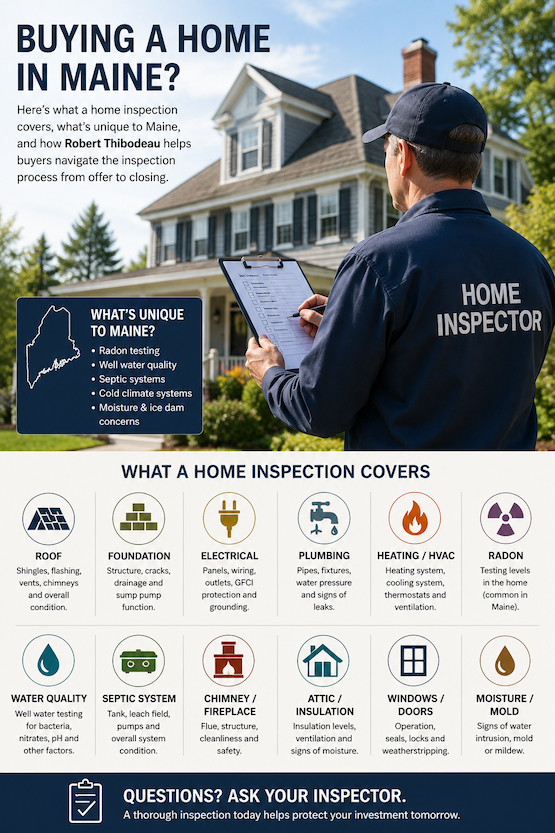
The Maine-Specific Inspection Checklist
Standard inspections cover structure, roof, electrical, and HVAC. Maine homes add several layers every buyer should address before closing.
Radon Testing
Maine has one of the highest radon rates in the country. Testing is inexpensive and negotiable — insist on it.
Well Water
Private wells require a separate water quality test. Arsenic and bacteria are the two key concerns in Southern Maine.
Septic System
Roughly 60% of Maine homes use private septic. Pump and inspect before closing — not after.
Oil Tanks
Buried tanks are a significant liability. A leak can cost six figures to remediate. Know the tank's age and status.
Radon: Maine's Silent Issue
Maine's geology puts a large portion of the state above the EPA's recommended action level for radon — which is why testing is standard practice here, not an optional add-on. The good news: a radon test turns around in a few days, and if levels are elevated, there's a fix. A mitigation system (typically a sub-slab ventilation fan) is a straightforward installation. Cost varies depending on the home's foundation type and layout — it can be quite reasonable, or a bit more involved. Either way, it's a solvable problem, and how it's handled is a conversation worth having with your agent before closing.
- Short-term tests return results in a few days — simple and inexpensive
- New construction is not immune — test regardless of home age
- Mitigation systems are effective and come with guarantees
- If elevated, the remedy is often a straightforward part of the negotiation
Septic Systems in Southern Maine
Most rural and many suburban properties in York County and Cumberland County rely on private septic systems. A professional pump-out and inspection before closing is non-negotiable. Key things to verify:
- Age and type of system — conventional, chamber, or pump-assisted
- Proximity to wetlands or shorelines — Maine DEP sets buffer requirements
- Permit history — was the system properly permitted? Any additions to the home since original install?
- Capacity — does the system meet the current bedroom count?
- Last service date — tanks should be pumped every 3–5 years
A failing or undersized system isn't automatically a deal-breaker. It becomes a negotiating point — remediation costs range from $5,000 for minor repairs to $25,000+ for a full replacement.
Well Water Quality Testing
Maine law requires sellers to disclose the existence of a private well, but does not require testing. That gap is your responsibility as a buyer. A standard well water test in Maine should include:
- Bacteria (coliform and E. coli)
- Arsenic — naturally occurring in Maine bedrock
- Nitrates and nitrites
- Lead and copper
- pH, hardness, and iron levels
- Radon in water (if your area is elevated for radon in air)
Testing costs $100–$350 depending on the panel. Treatment systems — whole-house filters, reverse osmosis, UV — range from a few hundred to a few thousand dollars and are very effective. Budget for annual testing after purchase.
Underground Oil Tanks
Older Maine homes — particularly those built before 1990 — may have underground oil storage tanks (USTs) that were decommissioned in place or simply abandoned when the home switched to a different fuel source. Finding one on a property you're buying is serious:
- Lenders may refuse to close on a property with an active UST
- Leaked petroleum contamination requires DEP-supervised remediation
- Remediation costs vary from $5,000 (minor) to well over $100,000 (soil/groundwater impact)
- Aboveground tanks are lower risk but still need inspection for leaks and age
- Maine DEP maintains a registry of known petroleum releases — worth checking
Always ask the seller for documentation. If tank history is unclear, hire a tank sweep as part of due diligence.
Thinking About Selling? Get Ahead of the Inspection.
Every home that sells in Southern Maine goes through a buyer's inspection. The sellers who come out ahead are the ones who already know what's coming — and have had the chance to address it before the offer lands on the table. I'm not a home inspector, but I've been through hundreds of transactions, and I know exactly what buyers and their inspectors focus on in this market.
Here's how I help sellers get their home ready before it hits the market:
Step 01
Pre-Listing Walkthrough
We walk the property together — inside and out — with the buyer's eye. I flag what's likely to come up in an inspection so there are no surprises.
Step 02
Repair & Remedy Guidance
Not everything needs to be fixed — but some things do. I'll help you prioritize what matters to buyers and lenders versus what's simply cosmetic.
Step 03
Pre-Sale Inspection Option
Some sellers choose to have their own inspection done before listing. It eliminates the unknown, builds buyer confidence, and gives you documentation to back up your pricing.
Step 04
Listing with Confidence
Buyers negotiate hardest when they're uncertain. A well-prepared home — with known systems, disclosed repairs, and clean paperwork — closes faster and closer to asking price.
If you're thinking about selling in Southern Maine — this spring, this fall, or sometime next year — a conversation now costs nothing and puts you months ahead.
Get a Home Value Estimate →What Happens During a Home Inspection in Maine
A standard home inspection in Maine takes 2.5 to 4 hours for an average-sized home. As a buyer, you should plan to attend — in person, at the end — to walk through findings with the inspector directly. Here's the typical sequence:
- Exterior and roof — flashing, gutters, grading, driveway, foundation visible from grade
- Structural systems — foundation, framing, basement, crawl space
- Mechanical systems — HVAC (boiler, furnace, heat pump), water heater, electrical panel
- Interior — windows, doors, insulation, attic, plumbing visible inside
- Buyer walkthrough — inspector explains findings, answers questions, clarifies what's material vs. minor
Within 24 hours, you'll receive a written report with photos. That report becomes the foundation of any repair request or price negotiation.
How to Choose a Home Inspector in Maine
Maine licenses home inspectors through the Department of Professional and Financial Regulation. When evaluating candidates:
- Verify their Maine HI license is active
- Ask if they carry errors and omissions (E&O) insurance
- Confirm they offer radon testing as an add-on (not all do)
- Ask specifically about experience with older homes, septic systems, and well water
- Read recent reviews — look for detail in how they describe their findings
- Expect to pay $400–$650 for a full inspection; add-ons (radon, water, mold) are separate
Your real estate agent can provide a short list of inspectors they've worked with — but the choice is always yours, and you're never obligated to use a recommended vendor.
Frequently Asked Questions
Can I skip the inspection on a competitive offer?
You can waive it — but in Maine, that means waiving discovery of potential radon, septic failure, oil tank contamination, and structural issues. In most cases, the risk far exceeds the perceived competitive benefit. There are alternatives (pre-inspection, inspection for informational purposes only) that keep the offer competitive without going in blind.
Who pays for the inspection?
The buyer always pays for the inspection — typically at the time of service, before the report is delivered. It's not rolled into closing costs. Budget $400–$650 for the main inspection, plus any add-ons.
What if the inspection reveals major issues?
You have options: request repairs, ask for a price reduction or credit at closing, require escrow holdback for incomplete work, or — depending on your contract language — walk away and recover your earnest money. Maine's standard purchase and sale agreement includes an inspection contingency period; how you respond is a strategic decision, not a panic moment.
Is a new construction home still inspected?
Yes — and it's strongly recommended. New construction passes code inspection, but code minimums and buyer-quality standards aren't the same thing. A private inspector will find items the town inspector simply doesn't check for.
How long does the buyer have for inspection after an offer is accepted?
Maine contracts typically allow 10–14 days for the inspection period. In a competitive market, tighter timelines are sometimes negotiated. Having an inspector ready to schedule quickly is an advantage.
Buyer Resources — Southern Maine
Areas We Serve in Southern Maine
Helping buyers and sellers across York County and Cumberland County
old orchard beach
·
saco
·
biddeford
·
scarborough
·
portland
·
south portland
·
cape elizabeth
·
kennebunk
·
kennebunkport
·
biddeford pool
·
buxton
·
limington
·
standish
Disclaimer: This guide is provided for general informational purposes only and does not constitute legal, environmental, or professional inspection advice. Home inspection findings, costs, and requirements vary by property, location, and inspector. Always consult a licensed Maine home inspector, attorney, or qualified professional for advice specific to your transaction. Rob Thibodeau is a licensed Maine Associate Broker (License #BA930057) with eXp Realty. Content is believed accurate as of the date published but is subject to change. All real estate transactions are subject to Maine law and the terms of any executed purchase and sale agreement.
 Listing data is derived in whole or in part from the Maine IDX and is for consumers' personal, non commercial use only. Dimensions are approximate and not guaranteed. All data should be independently verified ©2026 Maine Real Estate Information System, Inc. All Rights Reserved.